
 Jasu
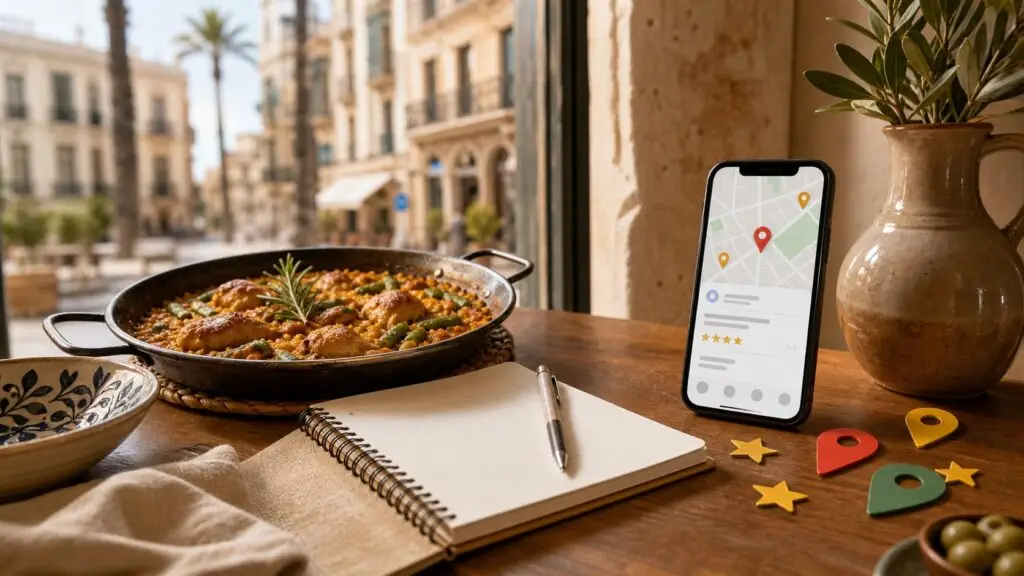
A restaurant can have good food, good service and a reasonable location, but if it doesn’t show up when someone searches for somewhere to eat on Google, Google Maps or their phone, it is losing bookings right at the moment of decision. SEO for restaurants in Valencia isn’t about attracting generic visits: it’s about appearing in searches driven by hunger, location and the intention to book.
As an SEO consultant in Valencia, I would work on a restaurant by combining local SEO, a website built for conversion, content by neighbourhood or type of cuisine, reviews, structured data and tracking of direct bookings. The idea isn’t to rely less on third-party platforms just for the sake of saying so: it’s to build your own channel that generates calls, clicks for directions, bookings and enquiries.
What someone is really looking for before booking a restaurant
Food searches are immediate. People rarely read ten articles before deciding; they compare options, look at photos, reviews, distance, the menu, approximate price and availability. That’s why the SEO strategy has to respond to a very specific intent.
Searches driven by an immediate need
These are queries such as “restaurant nearby”, “where to eat in Valencia”, “rice restaurant near me” or “dinner in Ruzafa”. Here Google tends to prioritise the local pack and Google Maps. The business profile, proximity, reviews, category and data consistency carry a lot of weight.
Searches by type of cuisine or experience
There are also searches such as “Italian restaurant in Valencia city centre”, “set lunch menu in Benimaclet”, “romantic restaurant Valencia” or “paella in El Palmar”. These queries make it possible to work on more specific pages and content, with a clear commercial intent.
Validation searches
Before booking, many users search for the restaurant’s name and check photos, the menu, opening hours, negative reviews, vegetarian options, whether there’s a terrace or whether it takes bookings. If that information is incomplete or scattered, part of the demand ends up at another venue.
The foundation: a well-managed Google Business Profile
For restaurants, the Google Business Profile isn’t an add-on. It is one of their main assets. In many local searches, the user decides from Google Maps without ever visiting the website.
Categories, attributes and NAP data
The primary category should accurately describe the type of restaurant. Attributes help answer filtered searches: terrace, accessibility, takeaway, bookings, vegetarian options, children’s menu or atmosphere. In addition, the name, address and phone number must match across the website, directories, social media and third-party platforms.
Photos that help people choose
Photos aren’t decoration. Google and users need to understand the frontage, atmosphere, dishes, menu, terrace and experience. A restaurant with up-to-date photos comes across as active; one with old or poor images creates doubt. It’s worth uploading photos by category and keeping a realistic pace.
Reviews and replies
Reviews influence rankings, clicks and bookings. Piling up stars isn’t enough: you have to reply naturally, address criticism and encourage reviews that describe dishes, the neighbourhood, the service or the type of experience. That adds semantic context and trust.
A restaurant website can’t just be a PDF menu
A restaurant website should load quickly, read well on mobile and convert. If the menu is a heavy image or an awkward PDF, Google understands less of the content and the user makes a worse decision.
An HTML menu and useful pages
The menu should be written as indexable text whenever possible. This makes it possible to rank for dishes, set menus, special options and types of cuisine. It also helps with specific searches: “tasting menu Valencia”, “arroz meloso Valencia” or “restaurant with gluten-free options Valencia”.
Bookings visible on mobile
The booking button, phone number, WhatsApp or form can’t be hidden away. In hospitality, every extra step reduces conversions. The site architecture should take the user from the search to the action without friction.
Speed and Core Web Vitals
Restaurant searches usually happen on mobile and in a hurry. A slow website, with huge images or intrusive pop-ups, loses users. This is where an SEO audit picks up technical issues that affect both crawling and conversion.
Local SEO by neighbourhood, area and type of cuisine
Trying to rank only for “restaurant in Valencia” is usually too broad. The real opportunity appears when you combine location, type of cuisine, dining occasion and what sets the restaurant apart.
Neighbourhoods with real intent
Ruzafa, El Carmen, Cabanyal, Benimaclet, Ciutat Vella, Cánovas or Valencia city centre can trigger different searches. That doesn’t mean creating thin pages for every neighbourhood, but working on the ones that make sense for the venue, its location and its customers.
Type of cuisine and dining occasions
A restaurant can target searches for rice dishes, tapas, Italian food, set lunch menus, brunch, group dinners, terraces, business lunches or celebrations. Each intent needs useful content, not an artificial repetition of keywords.
Landing pages that genuinely add value
A local page should explain the location, the offering, dishes, menu, photos, how to get there, bookings, frequently asked questions and trust signals. If only the neighbourhood name changes, it isn’t a strategy: it’s weak content.
What an SEO strategy for restaurants in Valencia would include
The plan depends on the starting point, but there are areas that are almost always worth reviewing. The priority should be on actions that can translate into bookings and your own demand.
Local and technical audit
I review the Google profile, website, indexing, speed, structure, titles, meta tags, contact details, duplicates, cannibalisation and consistency across platforms. For restaurants, small information errors can cost bookings.
Keyword research focused on tables, not traffic
The research should distinguish between informational searches, local searches, neighbourhood searches and searches with booking intent. Not every keyword with volume is a good one; some only bring curiosity.
Optimising the main pages
The home page, menu, bookings, contact, location, events, set menus and service pages should be aligned with search intent. Internal linking should push the pages that convert, not hand out links without any criteria.
Local and seasonal content
Hospitality has seasons, festivals, events, special menus and demand that peaks at certain times. Fallas, work Christmas dinners, summer terraces, group menus or special dates can all be covered with useful, commercial content.
Local authority
Mentions in local media, food guides, collaborations, consistent directories and relevant links help build trust. Where it makes sense, local link building can also be worked on.
Common mistakes that hold back a restaurant’s SEO
Relying solely on third-party platforms
Google Maps, social media, booking and delivery platforms can provide visibility, but they shouldn’t replace your own website. If all contact happens on third-party platforms, the restaurant loses margin, data and control.
Not replying to negative reviews
A negative review with no reply carries more weight than it seems. The reply should be brief, professional and specific. It isn’t about arguing; it’s about showing judgement and attentiveness.
Not measuring business actions
Measuring only organic traffic can be misleading. For restaurants, what matters is calls, clicks for directions, bookings, forms, WhatsApp, clicks on the menu and assisted conversions. Google Search Console, Analytics and the business profile itself help with prioritising.
When to hire an SEO consultant for restaurants
It makes sense to ask for help when the restaurant already has potential demand but doesn’t show up for relevant local searches; when it depends too heavily on Ads or platforms; when the website doesn’t convert; or when there are several venues and the architecture, profiles and tracking need to be organised.
If you need to improve your restaurant’s local rankings, I can help on the strategic and technical side: audit, Google Business Profile, content structure, internal linking, tracking and prioritising actions. You can see the general approach in my local SEO in Valencia service.
For local businesses with a lot of immediate intent, such as restaurants or florists, the approach has to bring together maps, reviews and conversion. For the latter, I’ve put together a specific guide to SEO for florists in Valencia.
Restaurants and hotels share local signals, reviews and location-based searches. For accommodation, that work takes the form of a SEO for hotels in Valencia strategy focused on direct bookings.
Restaurants that offer events, group menus or off-site services may need a strategy similar to SEO for catering in Valencia.
Restaurants, food and wine pairings and wineries can be strengthened with well-linked food content. The wine-specific approach is covered in SEO for wineries.
Venues that combine food, live music or events can reinforce that line with SEO for concert venues.
Restaurants on the coast or inland in La Safor may need their own local strategy; I develop it from the SEO in Gandia approach.
Restaurants located outside the city of Valencia may also need a geo-targeted strategy; here is the local SEO in Gandia approach.
Frequently asked questions about SEO for restaurants
How long does it take for SEO to make a difference for a restaurant?
It depends on the competition and the state of the profile, the website and the reviews. On Google Maps, signs can appear sooner than in classic organic results, but a solid strategy usually needs several months to settle.
Is optimising Google Business Profile enough?
Not always. The profile is key, but the website, reviews, local content, authority and data consistency also play a part. For competitive restaurants, it’s worth working on the whole system.
Should I create pages for every neighbourhood in Valencia?
Only if they genuinely make sense. A neighbourhood page should provide useful, specific information. If the restaurant has no commercial connection with that area, it may be artificial content that doesn’t help.
Should the menu be a PDF?
There can be a downloadable PDF, but the main menu should be in HTML, visible and easy to read on mobile. That way Google understands the dishes better and the user decides with less friction.
You can also check the official documentation for Google Business Profile and the Local Business structured data to understand some of the signals involved in local visibility.
This local acquisition approach also applies to businesses linked to leisure, bookings and experiences; that’s why it makes sense to work on a specific SEO for tourism in Valencia strategy when demand depends on seasonality, maps and searches with booking intent.
As in hospitality, there are businesses where conversion depends on nearby searches and immediate availability. SEO for hairdressers in Valencia makes the most of that intent to turn local visibility into appointments.

Technical SEO consultant in Valencia for more than 16 years. Speaker and organiser at WordCamp Valencia and author on the Semrush and Publisuites blogs. More about me


